

“I’m worried I’ll get it wrong.”
I can’t tell you how many times I’ve heard this from early childhood educators.
Sometimes it’s followed by, “I don’t want to offend anyone.”
Other times it’s, “I don’t know enough about Aboriginal culture.”
And occasionally, “I’d rather not do anything than do something tokenistic.”
I understand where these concerns come from.
Cultural responsibility matters, and there are very real consequences when Aboriginal knowledge is misrepresented, stereotypes are reinforced or cultural protocols are ignored.
But I also wonder what happens when our fear of making mistakes becomes the very thing preventing us from learning.
Because while we should never approach Aboriginal perspectives carelessly, doing nothing isn’t necessarily a culturally responsive choice either.
There is a difference between being appropriately cautious and becoming so afraid of getting something wrong that we avoid engaging altogether.
And I think this is a conversation we need to have more often in early childhood education.
When Educators Are Afraid to Begin
At the recent Early Childhood Australia Conference, I listened to educators from Goodstart Doncaster East share their journey towards strengthening Aboriginal and Torres Strait Islander perspectives within their service.
What I appreciated was their willingness to talk about where they started.
They didn’t present themselves as having always been confident or knowledgeable.
Instead, they acknowledged that uncertainty had been a significant barrier.
As they explained:
“When we first started strengthening Aboriginal Torres Strait Islanders’ practice, perspectives and practice, our educators lacked confidence. They were worried about saying or doing the wrong thing.”
I suspect this will resonate with many educators.
We know that embedding Aboriginal and Torres Strait Islander perspectives is an important part of our professional responsibilities.
We want Aboriginal and Torres Strait Islander children to see their cultures, identities and families reflected positively within our environments and programs.
We want non-Indigenous children to develop respectful understandings of the First Peoples of this country.
And we want our practice to move beyond tokenism.
But sometimes the distance between what we know we should be doing and what we feel confident doing can seem enormous.
Where do we start?
What resources are appropriate?
What can we teach ourselves?
When do we need cultural guidance?
What happens if we make a mistake?
These are reasonable questions.
The challenge is making sure they lead us towards learning rather than avoidance.
You Don’t Need to Be an Expert, but You Do Need to Be a Learner
One of the most significant shifts described by the Goodstart Doncaster East team was a change in how they approached educator confidence.
They explained:
“Through ongoing collaborative reflections, we’ve shifted our mindset, uh, from expecting them to be experts to encouraging them to become respectful learners.”
I think this is such an important distinction.
There is sometimes an unspoken expectation that educators should already know how to embed Aboriginal perspectives.
That they should understand local histories, cultural protocols, appropriate resources and Aboriginal pedagogies before they begin.
But for many educators, these are areas they may have had very limited opportunities to learn about themselves.
And that raises an important question.
How can we expect educators to confidently teach what they have never had the opportunity to learn?
Of course, being a respectful learner doesn’t mean we can simply make things up as we go along.
It means recognising what we know, identifying what we don’t know and taking responsibility for developing our understanding.
It means listening to Aboriginal voices.
Seeking reliable information.
Participating in professional learning.
Developing appropriate relationships with local Aboriginal communities.
And being willing to reflect critically on our own assumptions.
It also means understanding that we don’t have to be the cultural expert in every situation.
Sometimes our responsibility is to recognise that we aren’t the appropriate person to share particular knowledge.
That isn’t a failure.
It’s an important part of cultural responsiveness.
What Happens When Educators Learn History for the First Time?
One of the comments from the Goodstart Doncaster East presentation that particularly stayed with me was this:
“Our educators shared that they were learning this part of Australia’s histories for the first time. This realization was huge for us and really impacted our approach moving forward.”
I think this deserves some reflection.
Many Australians have grown up with significant gaps in their understanding of Aboriginal and Torres Strait Islander histories.
Depending on when and where they attended school, they may have learnt very little about colonisation, resistance, the Stolen Generations, Aboriginal activism or the continuing impacts of historical policies.
Some may have been taught versions of Australian history that centred European settlement while largely excluding Aboriginal perspectives.
Others may have encountered Aboriginal histories primarily through celebrations or cultural activities, without developing an understanding of the broader historical context.
And these knowledge gaps don’t disappear simply because someone becomes an early childhood educator.
They enter our services with us.
They influence the resources we select.
The conversations we feel comfortable having.
The questions we know how to answer.
And sometimes, the topics we avoid altogether.
I think we need to recognise that educator professional learning is not simply about collecting new activities.
It’s about developing the knowledge and understanding that informs our decisions.
Before we can meaningfully embed Aboriginal perspectives, we need opportunities to examine what we were taught, what we weren’t taught and how those gaps influence our practice today.
That doesn’t mean educators should immediately begin teaching difficult histories to young children.
As I’ve discussed in previous articles, there are significant considerations involved in introducing sensitive historical content, including cultural authority, developmental appropriateness, emotional wellbeing and family context.
But educators themselves need to be willing to learn.
Our own learning needs to be deeper than the experiences we eventually offer children.
From Individual Anxiety to Collective Responsibility
Another aspect of the Goodstart Doncaster East journey that interested me was the emphasis on collaborative reflection.
Their educators weren’t simply being encouraged to complete a training module and return to their rooms with a list of activities.
They were learning together.
Discussing their understanding.
Reflecting on their assumptions.
And considering how new knowledge could influence their everyday practice.
As the team explained:
“We found that when educators feel supported and empowered to learn together, this translates into a more confident and engaged teaching practice.”
I think this highlights an important responsibility for educational leaders.
If we want educators to develop cultural confidence, we need to create environments where professional learning is supported.
Where educators can ask genuine questions without being embarrassed.
Where uncertainty is acknowledged rather than hidden.
Where mistakes can be identified, addressed and learnt from.
And where culturally responsive practice is understood as a shared responsibility.
I’ve visited services where one educator has become the person everyone turns to whenever anything involving Aboriginal perspectives comes up.
They choose the books.
They organise NAIDOC Week.
They write the Acknowledgement of Country.
They decide which resources are appropriate.
And they become responsible for ensuring Aboriginal perspectives are visible throughout the service.
But what happens when that educator leaves?
Or moves into another room?
Or simply becomes overwhelmed?
Culturally responsive practice cannot depend on the enthusiasm or knowledge of one individual.
It needs to become part of the service’s collective professional culture.
From Cultural Activities to Cultural Responsiveness
One of my favourite quotes from the Goodstart Doncaster East presentation was:
“Our aim was not just to teach about Aboriginal culture but to embed it into our thinking and practice as a normal part of what we do.”
For me, this is where the real shift happens.
Because embedding Aboriginal perspectives isn’t simply about increasing the number of Aboriginal-themed experiences in the program.
It’s about reconsidering the thinking that sits behind our practice.
How do we view children?
How do we build relationships with families?
Whose knowledge do we value?
How do we approach planning and documentation?
What opportunities do children have to develop relationships with Country?
How do we represent Aboriginal and Torres Strait Islander peoples in our environments?
And how do we respond when children express misconceptions or encounter stereotypes?
These are pedagogical questions.
They influence how we teach, not simply what we teach.
For example, an educator might begin by purchasing a collection of First Nations picture books.
That can be a useful starting point.
But the deeper work involves considering how those books are selected, how they are shared, whose perspectives they represent and how they connect with children’s ongoing learning.
Similarly, educators might begin exploring the local environment with children.
But spending time outdoors isn’t automatically embedding Aboriginal perspectives.
We need to intentionally consider how relationships with Country, local Aboriginal knowledge and appropriate community connections inform our understanding.
Cultural responsiveness isn’t measured by how many Aboriginal resources we have. It’s reflected in the decisions we make and the relationships we nurture.
Confidence Grows Through Meaningful Experiences
Another theme that emerged from the Goodstart Doncaster East presentation was the importance of learning through practical experiences.
Rather than treating Aboriginal perspectives as an isolated curriculum area, the educators described developing projects that connected children’s learning with stories, identity, relationships and place.
They explained:
“We introduced this culturally responsive approach to our center leadership team, which focused on storytelling, identity, relationship, and connection to country.”
I think this provides an important reminder that cultural confidence isn’t developed through theoretical knowledge alone.
Educators also need opportunities to consider what their learning means in practice.
For example, a service might begin by investigating whose Country it is located on.
This could lead educators to learn about local Aboriginal organisations, appropriate community resources and the history of their local area.
They might then review the books available in their learning environments.
Are Aboriginal and Torres Strait Islander peoples represented as contemporary people?
Are the resources written or illustrated by First Nations creators?
Do the stories reflect the diversity of Aboriginal and Torres Strait Islander communities?
From there, educators might explore how their planning and documentation can better recognise children’s existing knowledge, family experiences and connections to place.
None of these steps requires educators to claim cultural expertise.
But they do require intentionality.
And over time, they can help educators develop the confidence to make more informed decisions.
What Does Respectful Curiosity Look Like?
I think curiosity is an important quality for educators.
But when we’re learning about Aboriginal and Torres Strait Islander cultures, curiosity needs to be accompanied by respect.
Respectful curiosity means being genuinely interested in learning while recognising that not all knowledge is ours to access, interpret or share.
It means understanding that Aboriginal and Torres Strait Islander peoples are not one homogenous cultural group.
It means being mindful that local knowledge may be subject to cultural protocols.
And it means recognising that Aboriginal families and colleagues shouldn’t be expected to answer every question we have.
Sometimes the most respectful thing we can do is begin with our own research.
Read First Nations-authored books.
Engage with reputable Aboriginal organisations.
Attend professional learning.
Listen to Aboriginal educators and knowledge holders who have chosen to share their expertise.
And develop relationships over time rather than approaching community members only when we need something for our program.
When we do seek cultural guidance, we need to respect people’s time, expertise and right to determine what they are comfortable sharing.
Curiosity should never become entitlement.
Five Ways to Build Cultural Confidence
If you’re an educator who wants to strengthen Aboriginal perspectives but isn’t sure where to begin, I’d encourage you to start with manageable, meaningful steps.
1. Begin with your own learning.
Reflect on what you know about Aboriginal and Torres Strait Islander histories, cultures and contemporary communities. Identify the gaps in your understanding and seek reliable opportunities for professional learning.
2. Learn about the Country you’re on.
Find out who the Traditional Custodians are, check appropriate names and pronunciation, and explore publicly available information about the local area.
3. Review your existing environment and resources.
Look critically at how Aboriginal and Torres Strait Islander peoples are represented. Consider whether your books, displays and resources reflect living cultures and contemporary identities.
4. Make professional reflection a team practice.
Create opportunities for educators to share questions, discuss their learning and critically reflect on the cultural assumptions informing their practice.
5. Focus on relationships, not just activities.
Consider how your learning is influencing relationships with children, families, Country and community. Look for ways Aboriginal perspectives can inform your pedagogy and everyday decision-making.
These steps might seem simple.
But meaningful change often begins with small decisions that are revisited and strengthened over time.
We Don’t Need Perfect Educators. We Need Responsible Learners.
One of the things I appreciated most about the Goodstart Doncaster East presentation was that the educators didn’t pretend their journey had been straightforward.
They acknowledged their initial uncertainty.
They reflected on gaps in their historical knowledge.
And they described how collaborative learning helped strengthen their confidence.
I think there is something important for the sector to take from this.
We need to stop expecting educators to become instant experts.
But we also need to stop allowing uncertainty to become a reason for inaction.
The answer isn’t to rush into activities without understanding.
And it isn’t to avoid Aboriginal perspectives altogether.
It’s to commit to learning.
To seek guidance.
To reflect.
To build relationships.
And to recognise that culturally responsive practice is an ongoing professional responsibility.
Because confidence doesn’t necessarily come from knowing all the answers.
Sometimes it comes from becoming more comfortable acknowledging what we don’t know and understanding what we need to do next.
The goal isn’t to become an educator who never makes a mistake.
It’s to become an educator who takes cultural responsibility seriously enough to keep learning.
Reflective Questions for Educators
- What fears or uncertainties have prevented us from strengthening Aboriginal and Torres Strait Islander perspectives in our practice?
- What gaps exist in our own understanding of Aboriginal and Torres Strait Islander histories and contemporary communities?
- Do educators in our service feel supported to ask questions, reflect and learn together?
- Are we relying on one enthusiastic educator, or is culturally responsive practice a shared responsibility?
- How are our professional learning experiences influencing our everyday decisions, relationships and pedagogy?
- What is one meaningful step we could take towards becoming more confident and culturally responsive learners?
Continue Your Learning With Koori Curriculum
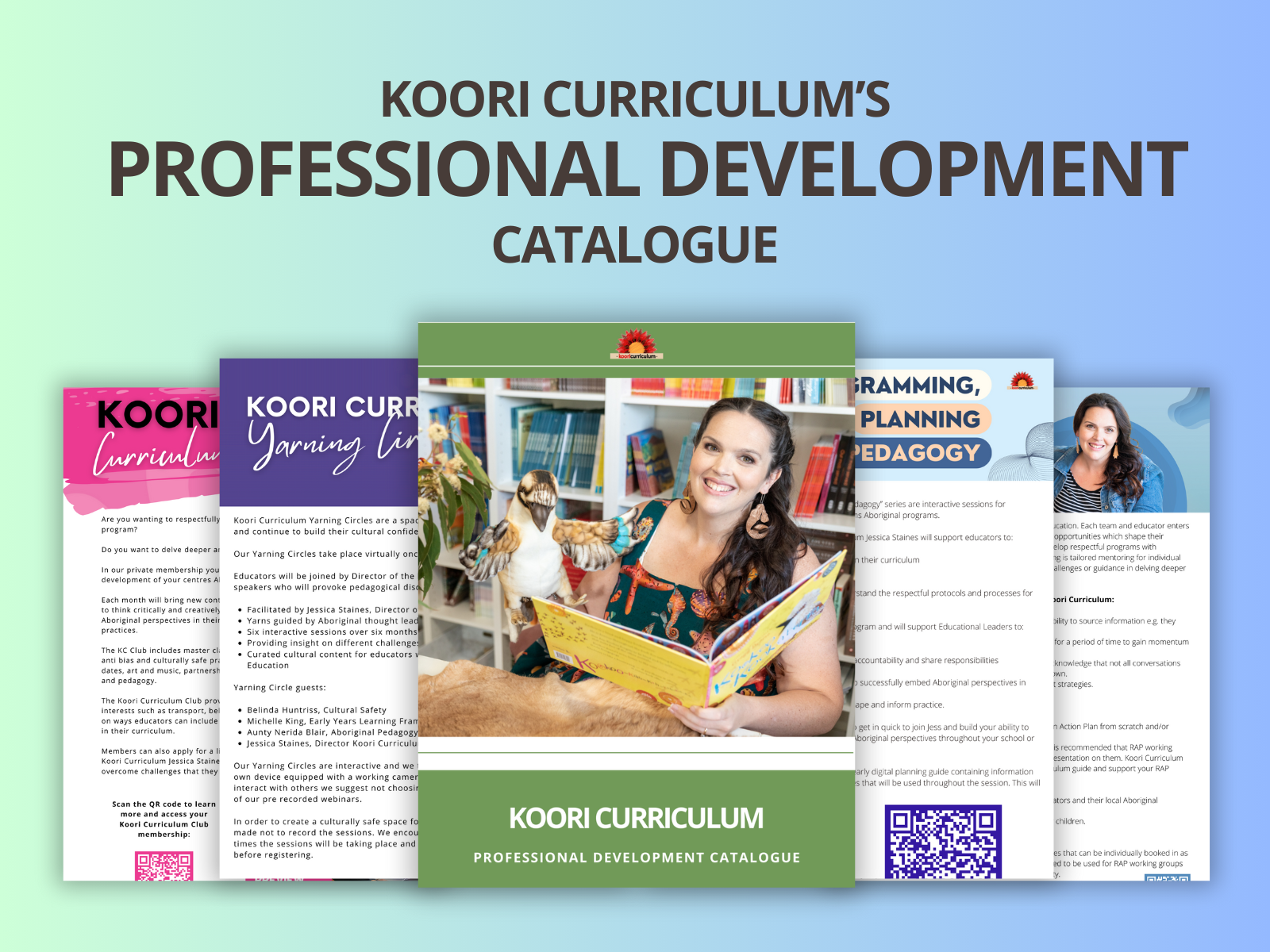
If this article has resonated with you, particularly if you’ve found yourself wanting to embed Aboriginal perspectives but feeling unsure where to begin, Koori Curriculum offers professional learning opportunities to support your journey.
Top 30 Tips in 30 Days
Our free Top 30 Tips in 30 Days professional development series offers practical starting points for educators who want to strengthen Aboriginal and Torres Strait Islander perspectives within their everyday practice.
It’s an opportunity to begin building your knowledge, reflecting on your current approach and identifying manageable steps towards more culturally responsive practice.
Embedding Aboriginal Perspectives Professional Development
For educators and teams wanting more structured support, our Embedding Aboriginal Perspectives professional development explores how Aboriginal ways of knowing, being and doing can inform early childhood environments, curriculum planning and relationships.
Rather than focusing on isolated cultural activities, we encourage educators to think critically about their pedagogy and develop approaches that are meaningful, respectful and sustainable.
Explore our professional learning opportunities at Koori Curriculum.
Because you don’t need to know everything before you begin.
But you do need to be willing to learn.
At Koori Curriculum, we support educators to move beyond tokenistic approaches towards meaningful, culturally responsive practice that honours Aboriginal and Torres Strait Islander peoples, histories and communities.
I’ve kept the Goodstart Doncaster East educators’ direct quotes central to the article, particularly their shift towards becoming respectful learners rather than cultural experts. That gives the piece a clear narrative without introducing the practices you wanted excluded.